
Essential Infrastructure
In many regions of the world experiencing rapid population growth, there remains a significant shortage of essential infrastructure and public services, given the surging demand for housing, education, healthcare and transport. At the same time, in wealthy countries, ever-increasing material consumption and greater mobility are driving up resource and energy consumption, making environmentally friendly systems both urgent and indispensable. Global pressure on the environment thus arises from two directions: from the development deficit of regions disadvantaged in terms of infrastructure, and from the optimism regarding consumption and mobility in rich countries; both require very different, yet rapidly implementable, responses.
Housing

Housing is a fundamental human need: having a roof over one’s head and a place where one feels “at home” is essential for individual well‑being, fosters community cohesion, and creates the stable conditions in which economic activity can flourish. At the global level, however, there is a growing housing shortage. Every year, additional building land are needed, more potable water, energy, and, as well as proper waste disposal, while at the same time climate‑relevant CO₂ emissions continue to rise globally. In this context, the way we build and manage housing will determine whether we can provide a satisfactory quality of life for everyone, even in seemingly little inhabitable areas. The use of highly insulating construction elements, bionic architectural concepts, and integrated concepts of energy, combined with a sharpened awareness of the needs and conditions of the inhabitants, will be crucial to addressing the housing challenge in a sustainable and equitable way
Ideas for project studies
Affordable Housing: E-homes in South Africa
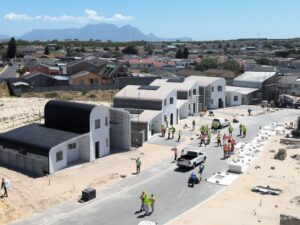
Based on prototypes of a quickly erectable, largely prefabricable and cost-effective “shellhouses”, which ELEPHants’ predecessor ANTHILLS developed under the impression of the devastation caused by the Haïti earthquake 2010 and the subsequent need for reconstruction, the construction company citra emerged as a spin-off in South Africa (RSA). citra further developed the system and adapted it to RSA’s affordable housing market. citra houses consist of polystyrene modules and concrete ribs, which are bonded with a special, fiber-reinforced mortar and completely plastered; together they then form a stormproof, fire-resistant, well-insulating composite structure. The mid-term goal is the construction of a mobile factory for the purpose of massive savings in building material transport costs.
African Coastal Lease Cities
Africa is experiencing staggering population growth. Over the next 25 years, Africa’s population is set to grow by an average of more than 3 million people – per month! To ensure that the growing number of young people have economic prospects, some 18 million jobs would need to be created annually in Sub-Saharan Africa alone – six times more than are currently created each year. It is clearly foreseeable that, under current conditions, many countries will not be able to adequately educate and integrate the masses of these additional people into the labour market; the risk of a demographic catastrophe rather than a demographic dividend is high. The establishment of attractive but clearly demarcated autonomous special economic zones or cities, leased and managed in the long term by independent social enterprises or progressive states, could create zones of prosperity for locals and foreigners alike. The success of such zones would rub off on the surrounding regions. A white paper and a Delphi study on extraterritorial leased cities in African coastal regions will be circulated in 2026.
Cost estimate for the launch and analysis of the Delphi survey: €25,000
Waste Management

Global environmental pollution caused by waste continues to rise, primarily due to increasing volumes of plastic, electronic waste and uncontrolled disposal of municipal waste, which exacerbates soil and groundwater contamination as well as health risks to humans and animals. Open rubbish dumps and fly-tipping sites are becoming contaminated sites that will endanger the livelihoods of future generations. Whilst many industrialised countries are increasingly relying on recycling, the circular economy and landfill technology, large parts of Africa, South Asia and South America often lack safe landfills, collection systems and regulation, leading to massive strain on ecosystems and local communities.
Ideas for project studies
Kitchen Forester: Reducing the Personal CO2 Footprint
Considerable amounts of potential energy are lost in modern waste incineration plants due to the fact that organic household waste has a high content of water with a high specific heat capacity, which must be vaporized before the combustible fractions can be incinerated. There are already various systems for composting kitchen waste to prevent excessive domestic waste from urban households and its unecological disposal. However, many of these systems do not work reliably or are bulky. The «Kitchen Forester» is cold rotting system and consists mainly of untreated wood; essential metal parts can be reused. The «Kitchen Forester» is easy to use, virtually emission-free, «foolproof», stylish and takes up very little space. At first glance, such a project might seem irrelevant, but every little helps, and when scaled up to millions of households, it can lead to huge savings in fossil fuel consumption. Several prototypes have already been tested.
Budget estimate for for three advanced prototypes: € 3000
Marine Plastic Collectors
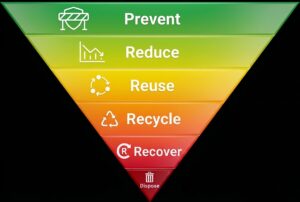
The cheapest, most practical and effective ways to avoid harmful plastic waste in the environment are to minimize the production of unnecessary products (especially packaging), use reusable beverage bottles, systematically collect waste (including skimming at river mouths), sanction improper disposal, sort and recycle plastic waste or dispose of it in an environmentally friendly way. On the other hand, however, the plastic waste already floating in the sea poses a major logistical and technical challenge for disposal. Pollution of the world’s oceans by floating plastic waste threatens marine life. Most plastic floating debris remains on the surface up to a depth of two meters, after which most plastic parts sink irretrievably to the bottom. “Marine Plastic Collectors” form a fleet of semi-autonomous plastic collectors that cruise through the so called Great Ocean Garbage Patches. Similar to combine harvester fleets on the vast plains of grain export heavyweights, a fleet of one or several dozen plastic harvesters swims at a very slow pace, at an angle to each other, through the most polluted areas of the sea. The units are GPS-controlled, autonomous, predominantly solar-powered and are looked after by a manned mother ship. The mother ship takes over the collected goods at intervals. In heavy seas, the collection machines are lowered below the surface.
For international drinks manufacturers like Coca Cola, who put billions of disposable plastic bottles into circulation every year, reaching even the remotest corners of the world, financing such a fleet would be a small matter and good PR.
Budget estimate for basic marine engineering calculations:
€ 30’000;
concept visualization: € 6000